Health care leader Eric Conley urges future health leaders to ‘disrupt with humanity’ in annual Mick Lecture series
It was perhaps no coincidence that Eric Conley opened his lecture about leading with humanity by telling those in attendance about his kids.
He and his wife’s three daughters were all field hockey players, and as adults today work as an attorney, a sales professional (and marathoner) and an asset manager.
“They will be far more successful than I am, and my legacy that I hope to actually leave is how well they create their lives and their careers,” he said as part of the VCU Department of Health Administration’s 2025 Stephen S. Mick Lecture.
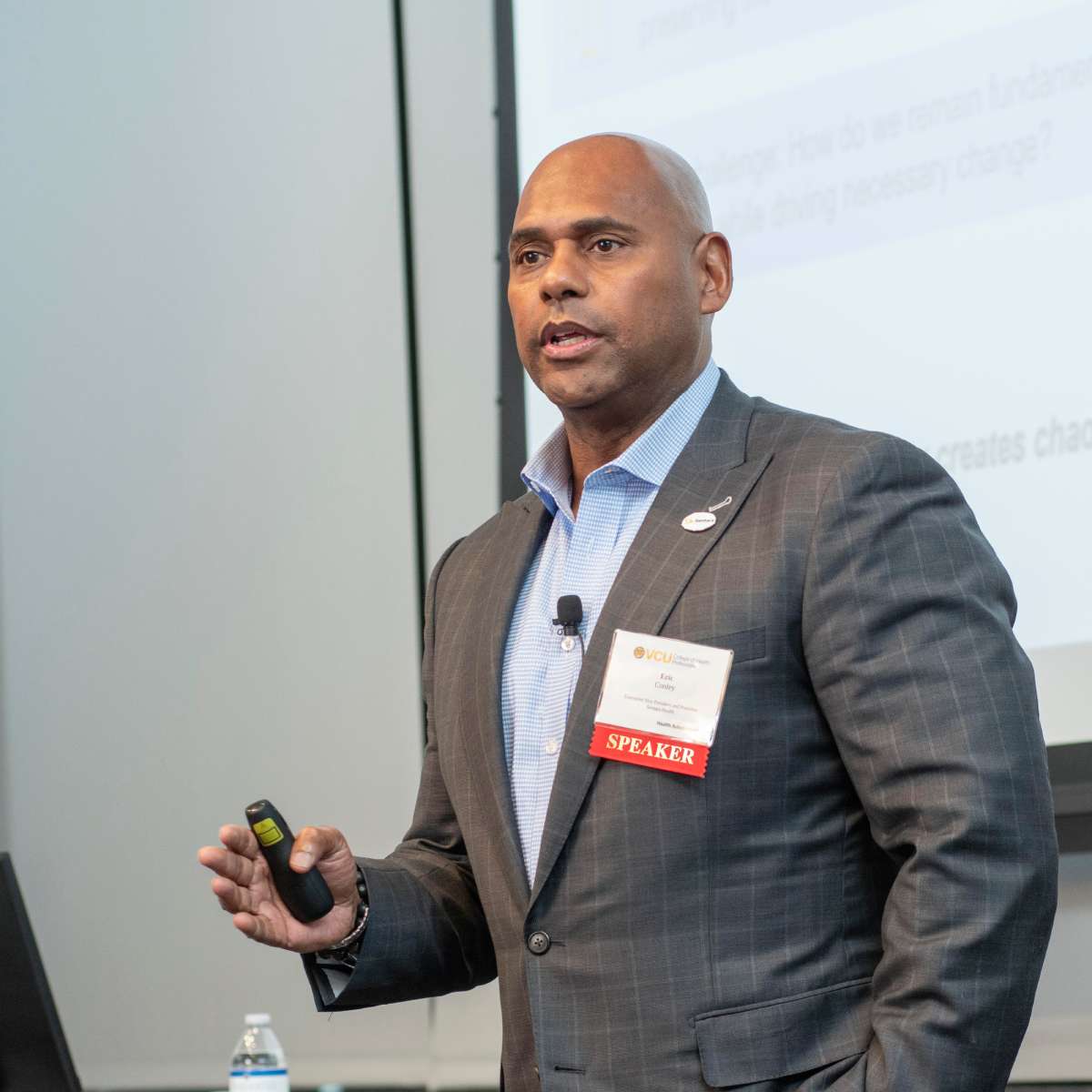
Because for Conley, executive vice president and president of Acute and Post-Acute Care at Sentara Health, the only loyalty anyone should have is to themselves and their families. “Period,” he said.
Yet the concept of loyalty goes both ways: An organization is loyal only to itself, he said. That means employers must make difficult decisions in the organization’s best interests, even if the result is unpopular or hurts the livelihood of employees. “Always be prepared for some sort of disruption” in your workplace, he said.
That is the same guidance he offered to Sentara employees as part of a major restructuring he led soon after joining the organization in April 2024. Historically, Sentara operated with 12 individual hospital presidents. Conley moved to eliminate most of those positions and reorganize the system into four regional markets with market presidents and operational, medical, and nursing vice presidents.
The shift, he said, was driven by strategy and cost – particularly in the highly concentrated Hampton Roads market, where several Sentara hospitals sat within minutes of each other. He described a “window to move” on an opportunity that would have been more difficult to implement in the future.
“We were, in many ways, competing against ourselves,” Conley said. Surgeons could play hospitals off each other over devices and preferences, he noted, which drove up costs even as margins remained strong. “By making this change, you can’t do that anymore.”
Some inside the organization called the process “The Hunger Games,” though Conley pushed back on that framing while acknowledging the stakes.
“I had to be blunt. I told them the structure was changing and this was not personal — it was for the betterment of the organization — but I understood that it was personal to those people,” he said. “We treated everyone impacted as humans.”
He provided a clear timeline, promised that everyone would be considered for new roles and committed to severance, transition roles and support for those who ultimately left. And he made clear that all factual information would come from him only, and anything else was a rumor.
His lesson to students: When you make hard decisions, lead with humanity.
“Disruption without humanity does create chaos,” Conley told students. “Humanity without disruption is stagnant. You cannot be stagnant in this world today.”
‘Don’t be afraid to fail’ – and don’t lead from the title
When a student asked about common mistakes new leaders make, Conley emphasized fear and ego.
Another mistake, he added, is relying on what they’re told rather than learning the work and asking questions.
“You don’t have to be the smartest person in the room, because you won’t be in the beginning,” he said. Early on, young leaders should spend time understanding frontline work and listening to those with decades of experience.
Earlier in his career, for example, he took responsibility for a health system’s pharmacy, lab and radiology divisions– all led by people with 25 or more years in the field.
“What can I teach them? Not a single thing,” he said. “What I approached them with was, ‘I can’t tell you anything. I can make sure your voice is heard at these tables. What I really am looking for is – what can I learn from you?’” Once those elder leaders understood his position, he was set up to succeed and they were happy to help.
He also admitted his own missteps, including a costly attempt to shut down a physician billing company without asking for enough help.
“The failure there was not that I didn’t know how to do it,” he said. “I didn’t ask for help. I had too much ‘I want to do this for me’ and not enough of ‘What’s in the best interest of the organization?’”
Ubuntu and the essence of being human
 Conley anchored his leadership philosophy in the African concept of “Ubuntu,” which he first encountered in a Netflix sports documentary.
“‘I can’t be all that I can be unless you are all that you can be,’” he said, quoting the idea. “Ubuntu is the essence of being human.” He linked that concept to how he leads teams through crisis and change, from the COVID-19 pandemic to major system restructuring.
That mindset, he said, is about “relationships with your team,” vulnerability and a belief that shared success matters more than individual credit.
He pointed to the long-running stability of the Pittsburgh Steelers – his favorite NFL team – as another example of values-driven leadership and thoughtful disruption, citing their continuity at head coach and their role in hiring and promoting Black coaches and scouts.
AI ‘will destroy us’ if misused
As modern-day lectures go, Conley’s conversation eventually turned to artificial intelligence, which he described as both unavoidable and potentially dangerous if treated as an “easy button.”
“If we do it as an easy button, it will destroy us,” he said. “If it’s garbage in, it’s garbage out.”
He told students that AI tools in health care are only as good as the underlying data and the humans who design and monitor them. At Sentara, he said, leaders recently revisited AI plans after realizing documentation in the electronic health record was inconsistent – a problem that would have led to flawed models.
“You have to know the work. You have to critically think in every aspect,” he said. “It’s not AI – it’s the human who coded that. So don’t be afraid to challenge it.”
Broad impact beyond the C-suite
Conley also spoke about his national role as board chair of the National Association of Health Services Executives, an organization focused on improving community health and advancing Black health care leaders. He described decades of work on student case competitions and community investments, and his commitment to reducing health disparities.
“It is important, as we face any unprecedented change, to look at everyone as human beings, period,” he said. “No matter what they look like, where they come from, how they speak, their views – they’re human beings.”
The annual Stephen S. Mick lecture honors its namesake faculty emeritus, who served as the Arthur Graham Glasgow Endowed Chair of the Department of Health Administration for a decade, ending in 2009. The Mick lecture supports the Department of Health Administration in bringing in guest speakers to address current and relevant topics in the industry.